

“I approach each image as an individual and ask it: ‘How would you like to appear?’”
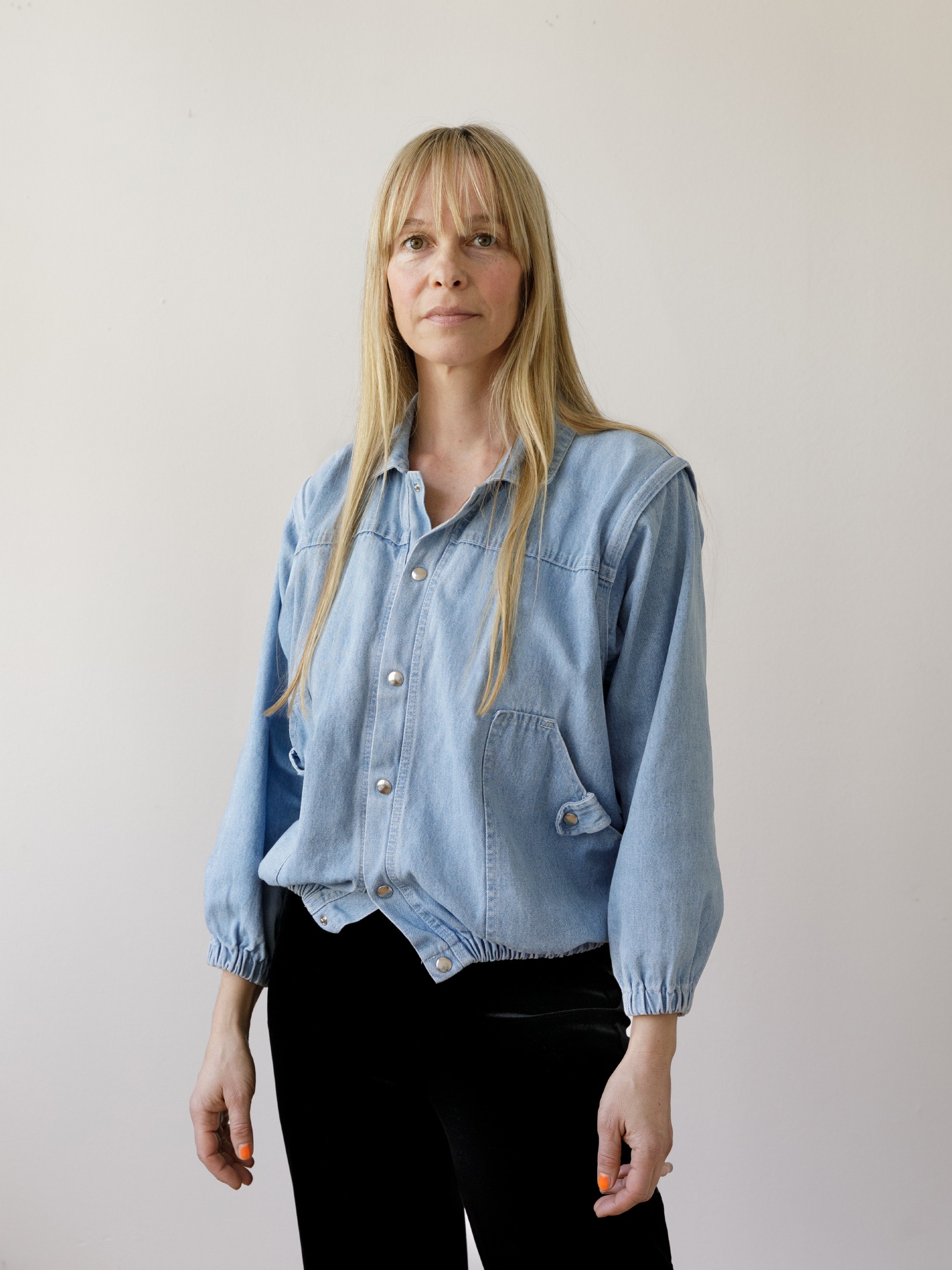
Kaarina-Sirkku Kurz is the 2026 guest artist at the Finnland-Institut as part of the Visiting Art/ist programme. The Berlin-based artist works primarily in the field of photography; in her exhibition 'Reaching, Grasping, Wondering', three bodies of work reveal a wide variety of thematic approaches, striking technical realisations, and an exploration of materiality. Linnéa Sverker spoke with Kaarina-Sirkku Kurz about her artistic practice.
Can you share a little bit about your background?
I grew up bilingual in Steinau an der Straße. My Vater (DE: father), my äiti (FI: mother), my sister and I spent our summers in Finland surrounded by our extended family. As a teenager, I felt the need to spend more time in Finland than just during the holidays, and to get to know the country independently of my family. So, after completing my intermediate diploma at the University of the Arts in Bremen, I decided to spend a semester abroad in Helsinki. Ultimately, I continued and completed my studies there, and lived in Finland for a total of seven and a half years.
Please tell me about your studies!
To me it wasn’t a given that I would ever go to university. I saw higher education as an absolute gift.
After completing an apprenticeship as a tailor, I initially studied costume design at the HfK in Bremen. But after my third semester, I shifted my focus to photography. When I went to TaiK, later renamed Aalto University, the attitude and approach to photography there was completely different from what I was used to in Bremen. In Helsinki, I also learned to embrace a more open process, in which things only take shape through the act of making them. A key realization for me was that artistic work involves both intuitive and analytical phases that, while interdependent, occur at different points in time. My personal experience during my studies in Germany was that we were expected to know in advance what we were making, and be able to justify why we were making it and how we intended to make it. In that respect, the way of working in Helsinki was a new experience for me, one that continues to guide me to this day.
How do you arrive at an idea for a new work?
I wouldn’t say that a work begins with something like an idea. The starting point is usually an observation, something that unsettles me, or a similar state of heightened awareness from which a question arises and sets me in motion. The visual work then develops out of a sense of wonder at the things I encounter along the way. My work is something of an attempt to find my way in the world, to make a little more sense of it. Of course, it also seems to be a never-ending process, because new questions keep emerging and that sense of wonder somehow never really goes away.
What led you to choose cosmetic plastic surgery as the starting point for the Supernature series?
The things I explore find their way to me. That’s how Supernature evolved from my previous work, Ungleichgewicht, which deals with the subjective, embodied experience of eating disorders. I worked very closely with people affected by these disorders, and through that experience I came to understand that the healing process is fundamentally about changing one’s relationship to and perception of one’s own body. You could say it’s like healing from the inside out. This led to the question of what it means when a person develops the desire to have their own body altered from the outside, with the intention of structurally reshaping it. This question ultimately led me into the operating room, where many of the works in Supernature were created.
Cosmetic plastic surgery is also about the body as material and the materiality of the body. This has led me to be even more aware of the materiality of the physical works in the context of the exhibition. I approach every photograph, every image, as an individual and ask it: “Who are you? How would you like to appear? How big are you? Are you framed or not?” and so on. This has made me aware of the important role materiality plays in the reception of works. It is not about materiality itself, but about what it does in relation to the motif.
A photograph from the series Vom Fremdsein in der Welt shows a still life of arranged objects, framed in a bold blue. What are these objects?
I was given access to an apartment where a person had died. Their passing initially went unnoticed because they had no relatives or friends. During the apartment clearout, I intuitively selected objects and arranged them just as intuitively in my studio to then photograph. The colour of the frame was an aesthetic choice inspired by one of the objects depicted: a candlestick made of six blue horseshoes. The exhibition at the Finnland-Institut also includes a photograph of a withered houseplant. That plant also came from the same apartment clearout.
With Soft Code, you’re moving away from photography in the traditional sense. What inspired you to work with textiles and weaving techniques?
At a conference on AI and art, it was mentioned that looms are often referred to as the first computers. That caught my attention, certainly in part because of my Finnish roots, and also the fact that Finland has a very strong tradition of weaving and textile art. While researching looms, computers, and the binary principle within weaving, I realised that digital photographs are, of course, also based on a binary system: image information represented by zeros and ones. This led me to ask what becomes visible when I faithfully transfer the binary code — in other words, the DNA of a digital image — onto a loom.
This question led me to Soft Code and to weaving. My weaving studies are produced in Helsinki, at the wonderful Välitila Studio.
What would you say has been the highlight of your career so far?
I find it amazing that I’m basically still doing exactly what I did while I was studying: working out of my sense of wonder, asking questions about the world and exploring them. I consider it a great gift that I’m able to live this way — it’s anything but a given. I keep sending greetings out into the universe and hope I’ll be allowed to continue doing so.
Edited by: Linnéa Sverker and Vera Kurkinen, translation from German: Ramona Tyler
13.2.–19.11.2026 | Kaarina-Sirkku Kurz: Reaching, Grasping, Wondering